A Brief History of Green Hills East
Nashville’s first Green Hills neighborhood
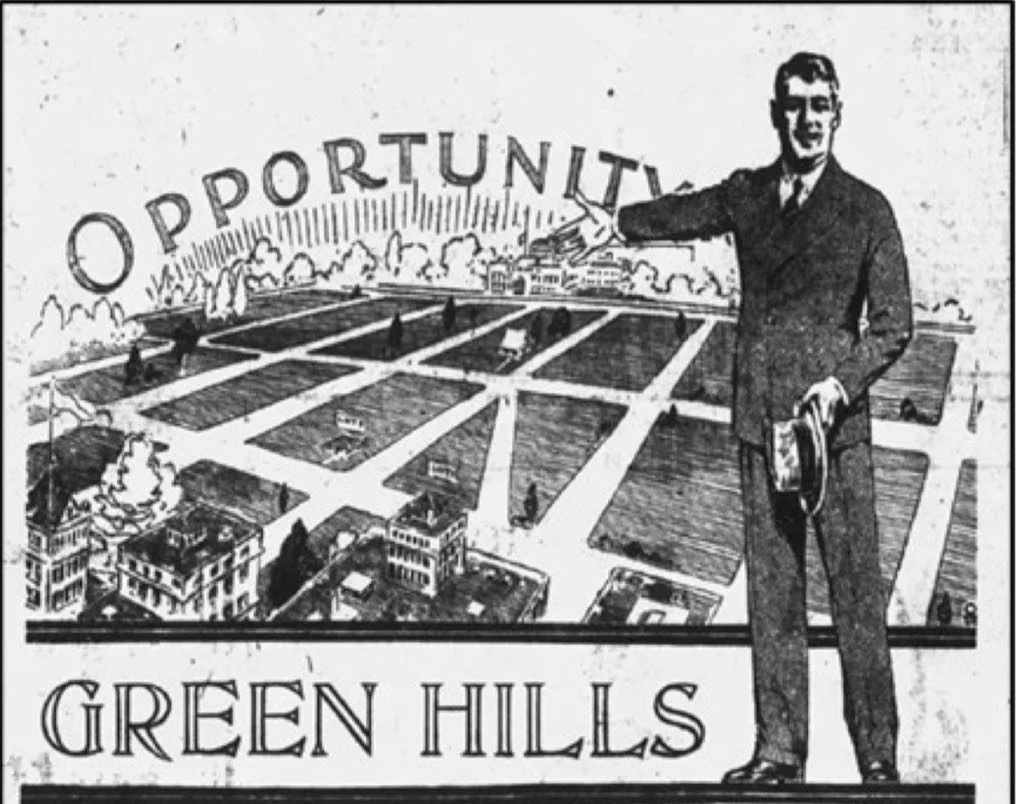
Advertisement from the Tennessean, April 10 1927
The Beginning
Developer John Calhoun filed two plats, or detailed maps, in 1926 and 1927 for land that had previously been owned by the Nashville Bible School and the Lipscomb family. He deliberately chose the name "Green Hills" as a marketing tool — promoting clean air, beautiful land, and a new kind of suburban living as an alternative to city life. Advertisements described the development as being on a "plateau that overlooks the knobs" with a "wealth of big shade trees and plenty of luxurious grass."
The first plat included North and South Observatory Drives, where work first began on streets and infrastructure. The second plat created Bonner Avenue, Green Hills Avenue, Shackleford Road, and Eden Avenue.
The Model Home Movement
Green Hills East holds a unique place in Nashville history. The very first home built in the subdivision — at 1637 South Observatory Drive — was Nashville's entry in a national model home demonstration program organized by the Home Owners Service Institute, supported by figures including former President Theodore Roosevelt Jr. and tied to President Warren Harding's post-WWI vision of stronger American communities built around the home.
This model home initiative was part of the national Better Homes in America campaign — a Progressive-era movement that aimed to promote home ownership, improve construction standards, and strengthen communities across the country. Green Hills East was Nashville's direct contribution to that movement.
Construction of the home was covered extensively by The Tennessean, and the project was used to educate Nashville residents about quality materials and construction practices. On May 1, 1927 -- opening day -- 15,000 visitors toured the home. It was designed by the Nashville firm of Tisdale, Stone and Pinson and sold for $12,000 to Holt and Salome Bean later that month.
The Streets and Their Names
Each street in the neighborhood carries its own history:
Bonner Avenue is named for T.F. Bonner (1861–1939), the entrepreneur whose farm constituted a portion of the development. The Tennessean in 1907 called him "one of Nashville's most progressive citizens."
Burton Avenue was named for Andrew Mizell Burton (1879–1966), founder of Life and Casualty Insurance Company and a major supporter of Lipscomb University.
Eden Avenue takes its name from the neighborhood's verdant, rural character — possibly an allusion to the Garden of Eden, consistent with the arcadian marketing of the development.
Observatory Drive was named to reflect the high elevation and views the lots commanded. It was the first street developed in the subdivision.
Then and Now
The neighborhood was developed and sold as a respite from urban living — and it remains one today, with quiet streets, old-growth trees, and many of the original buildings still standing. The original architectural forms, designs, and settings remain evident throughout.
Metro Nashville's Historic Zoning Commission has formally documented the neighborhood's period of significance as 1927–1960, and has identified its typical building forms as bungalows, English cottages, Minimal Traditional, Colonial Revival, Tudor Revival, and Ranch styles.
Neighbors have acted collectively before to protect the neighborhood: a resident-led effort successfully downzoned the area to single-family in 2006.
The conservation overlay now under consideration is the next chapter in that same tradition of neighbors looking out for what makes Green Hills East worth protecting.
*Historical research sourced from Metro Nashville Historic Zoning Commission, Neighborhood Conservation Zoning Overlay Part II: Green Hills East (2025).